

Hello,
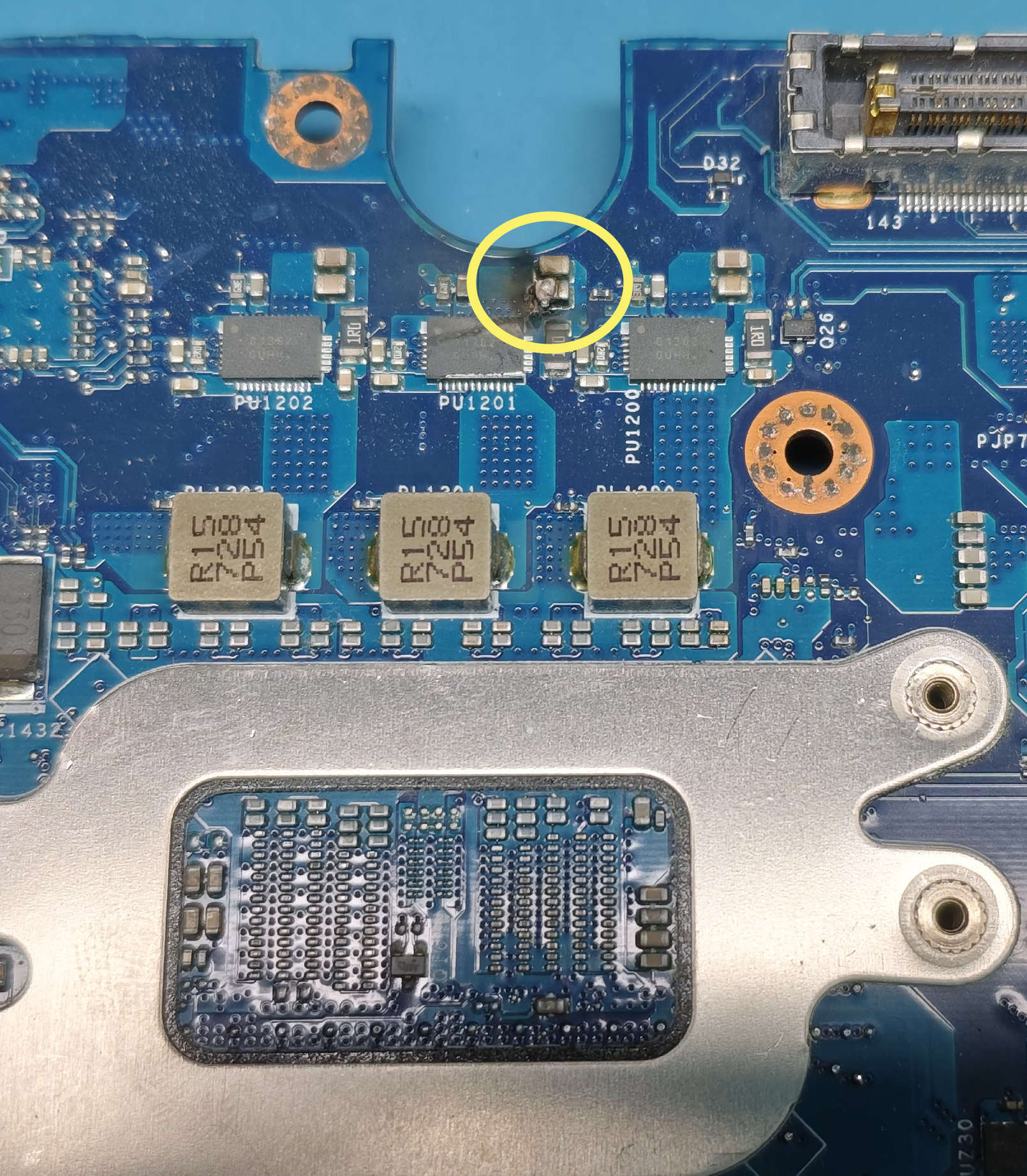
On this laptop, the first mosfet (PQ5) after the DCIN connector was burnt, so I have removed it. I then discovered an exploded capacitor near PU1201. This capacitor has been removed, but I still have a 0.0Ω short to ground after mosfet PQ701. I have also removed PU1201, but still the short remains. Injecting voltage does not help, as only the grounds are heating up, so the short must be quite large.
I have removed coils PL1200, PL1201 and PL1202 and have a resistance to ground through the CPU (Intel i7-6920HQ) of 1.1Ω. This seems very low, but maybe OK for this processor, I'm not sure. If I inject 0.8v onto the coil pad, I have a current draw of 0.9A.
Before I investigate further to try and find the short to ground, can anyone confirm if the resistance I'm seeing for this CPU is OK?
Board marking is CAP10 LA-E321P Rev 1.0 (A00)
On this laptop, the first mosfet (PQ5) after the DCIN connector was burnt, so I have removed it. I then discovered an exploded capacitor near PU1201. This capacitor has been removed, but I still have a 0.0Ω short to ground after mosfet PQ701. I have also removed PU1201, but still the short remains. Injecting voltage does not help, as only the grounds are heating up, so the short must be quite large.
I have removed coils PL1200, PL1201 and PL1202 and have a resistance to ground through the CPU (Intel i7-6920HQ) of 1.1Ω. This seems very low, but maybe OK for this processor, I'm not sure. If I inject 0.8v onto the coil pad, I have a current draw of 0.9A.
Before I investigate further to try and find the short to ground, can anyone confirm if the resistance I'm seeing for this CPU is OK?
Board marking is CAP10 LA-E321P Rev 1.0 (A00)